Mandated, Not Monetised: Making Co-Located Storage Profitable in the Philippines
By Patrick Tan ·
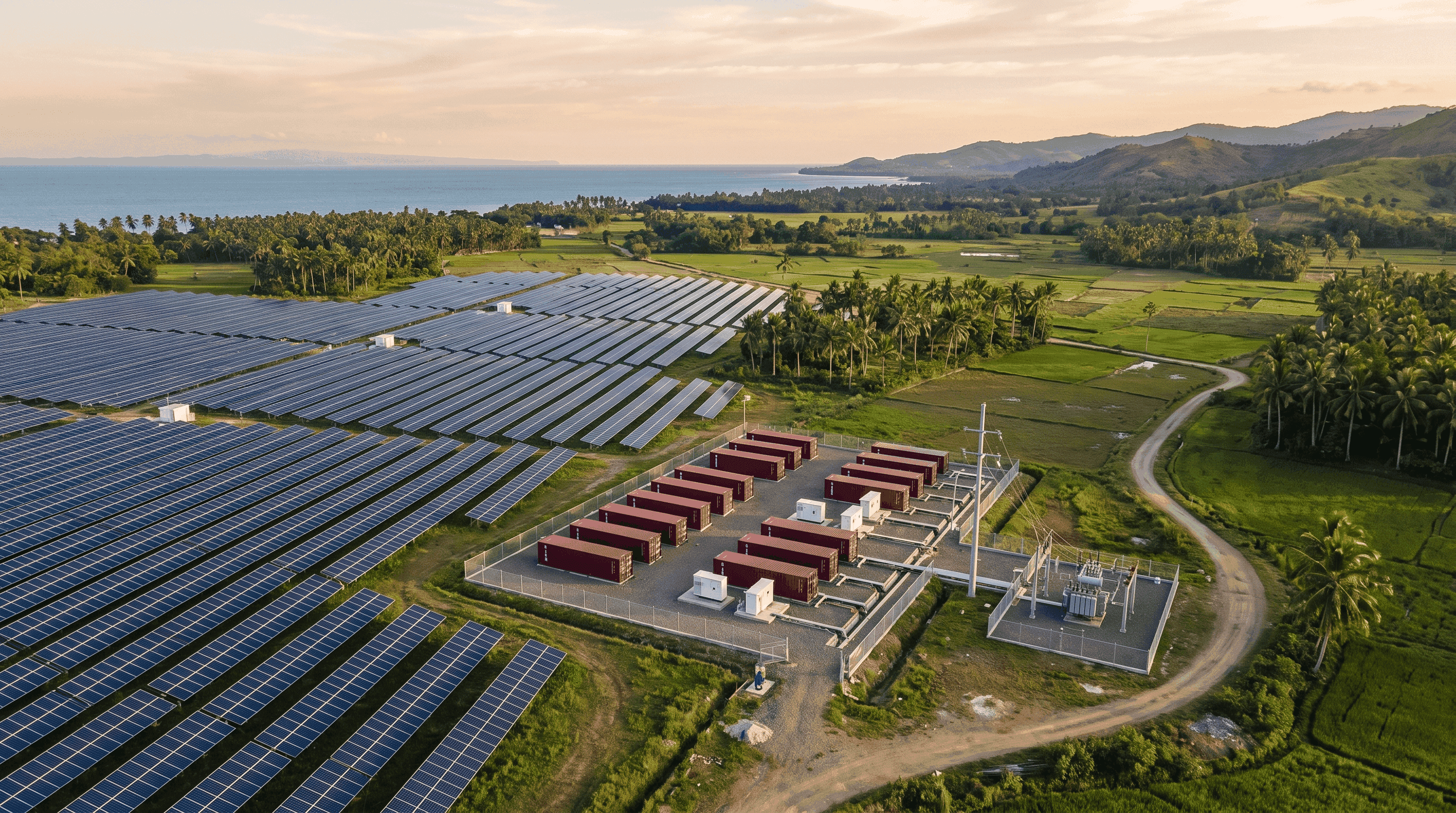
In February 2026 the Department of Energy (DOE) announced a new storage mandate: renewable projects above 10 MW must install energy storage worth at least 20% of their installed capacity.
Co-located batteries were not new to the market. Developers had been exploring them on commercial basis, as a way to convert intermittent solar into a product that buyers would contract for. A good example is MTerra Solar in Nueva Ecija and Bulacan, which pairs 3,500 MWp of photovoltaics with 4,500 MWh of storage and sells to Meralco for 850 MW of contracted capacity averaging 12 hours a day over 20 years horizon. Without the battery, that contract does not exist.
What changed in February is that installing a battery is no longer a choice, but a regulation to comply. Storage was an option for developers who wanted to sell a firmer product. It is now a condition of connection. As solar installation accelerates, the system needs more flexible capacities to firm them. This is DOE’s intent to secure a greener future for the Philippines, while ensuring grid stability.
And, that leaves developers with a narrower question: how does a battery they are now obliged to build can earn a return? The Philippine market offers three answers, and the historical record shows what each has been worth.
Solar cannibalisation is the driver, but location matters
The primary revenue stream is energy arbitrage — charging when power is cheap and discharging when it is expensive. What a battery earns from it depends on the price spread: the gap between the cheapest and most expensive hours of the day. A two-hour spread measures the average daily difference between the two cheapest and two most expensive hours, and is the standard economic metric to measure the feasibility of a two-hour battery in a liberalized market. The wider the spread, the more each cycle is worth.
What widens the spread in the Philippines is solar cannibalisation on the Luzon grid. Solar plants generate at the same time as one another, so as capacity grows, midday supply rises faster than midday demand and prices in the middle of the day fall. The average price a solar plant receives therefore drops below the market average — a ratio known as the solar capture rate. Cannibalisation is a problem for solar plants but it is the business case for batteries. The same midday collapse that erodes solar revenue widens the daily range storage exists to exploit.
Table 1 — Solar build-out, capture rates and price spreads, 2024–25
| Region / year | Solar capacity (MW) | Avg price (PHP/MWh) | Solar captured (PHP/MWh) | Capture rate | 2h spread (PHP/MWh) | Spread as % of price | | ----------------- | ----------------------- | ----------------------- | ---------------------------- | ---------------- | ----------------------- | ------------------------ | | Luzon 2024 | 2,159 | 5,465 | 4,831 | 88% | 9,713 | 178% | | Luzon 2025 | 2,703 | 3,928 | 2,973 | 76% | 7,808 | 199% | | Visayas 2024 | 571 | 6,760 | 5,818 | 86% | 13,922 | 206% | | Visayas 2025 | 739 | 5,122 | 4,310 | 84% | 11,742 | 229% |
For the last 2 years, Luzon added roughly 545 MW of solar between 2024 and 2025, taking installed capacity to 2.7 GW. And, the solar capture rates fell from 88% to 76%, about 12% in a single year. Over the same period, Visayas added around 170 MW, reaching 739 MW, and capture rates slipped from 86% to 84%.
Spreads moved with them too. In absolute terms, Luzon two-hour spread fell from 9,713 PHP/MWh to 7,808 PHP/MWh, but so did the average price, from 5,465 PHP/MWh to 3,928 PHP/MWh. Measured against the prevailing price level — the more meaningful comparison for a battery — spreads widened, from 178% of the average price to 199% in Luzon and from 206% to 229% in Visayas. Relative volatility is rising even as the absolute price level falls. [Side note: 2025 was an exceptional year for the Philippines, in which multiple factors drove the depression of spot prices. If you are keen to learn more, please reach out to the Aurora team to discuss more.]
That is a lucrative environment for merchant batteries. However, these are regional averages, and unfortunately no asset earns a regional average in the Philippines.
The Philippines runs a nodal market, so each plant settles at its own locational marginal price — the siting effect that decides renewable returns. Congestion can sharpen the midday collapse wherever transmission cannot move solar output to load, which penalises the solar plant but rewards a battery behind the same connection point.
Table 2 — Average daily 2h spread at selected nodes, PHP/MWh
| Node | 2024 spread | vs avg | 2025 spread | vs avg | Province | | ---------------------------- | --------------- | ---------- | --------------- | ---------- | ------------- | | Luzon regional average | 9,713 | — | 7,808 | — | — | | Tuguegarao | 10,393 | +7% | 8,293 | +6% | Cagayan | | Gamu | 10,237 | +5% | 8,198 | +5% | Isabela | | Santiago | 10,088 | +4% | 8,037 | +3% | Isabela | | Bayombong | 9,951 | +2% | 7,869 | +1% | Nueva Vizcaya | | Cabanatuan | 9,896 | +2% | 7,912 | +1% | Nueva Ecija | | Visayas regional average | 13,922 | — | 11,742 | — | — | | San Jose | 19,305 | +39% | 12,023 | +2% | Antique | | Nabas | 18,798 | +35% | 12,536 | +7% | Aklan | | Panitan | 18,520 | +33% | 12,205 | +4% | Capiz | | Dingle | 18,292 | +31% | 11,945 | +2% | Iloilo | | Santa Barbara | 18,238 | +31% | 11,880 | +1% | Iloilo |
Location can be worth a great deal. A battery at Nabas in 2024 saw spreads 35% above the Visayas average; at San Jose in Antique, 39% above. On a two-year average Nabas ran roughly 20% ahead of the region. For an asset whose arbitrage revenue scales directly with the spread, that is the difference between a marginal project and a strong one.
But the same table is a warning against extrapolation or simple regression. The Visayas premium did not persist: Nabas fell from +35% in 2024 to +7% in 2025, and San Jose from +39% to +2%. Nodal prices are a function of grid congestion and local dispatch dynamics, both of which move quickly. Luzon shows the opposite pattern — a smaller premium, but a stable one, with Tuguegarao holding +7% and +6% across the two years. Historical nodal performance is evidence of what congestion did, not a forecast of what it will do.
And, transmission build-out is the main driver of Philippines nodal dynamics. The 2026 Transmission Development Plan (TDP) records 126 transmission projects delayed against the previous plan, 67 of them by three years or more, largely due to right-of-way and permitting grounds. Each delay is a connection that renewable developers had been counting on to evacuate power — and each will reshape the congestion map that determines nodal spreads. A siting decision made on 2024 alone is a bet that none of this matters.
Aurora’s Philippines Nodal Market Forecast models these dynamics forward, providing long-term price and spread forecasts at individual node level, the resolution that siting decisions require, and a forward view that historical data cannot supply. If you are interested, please reach out to aileen.hong@auroraer.com to explore more.
The Reserve Market is still nascent — but it is a race to pick the first fruit
The Reserve Market, launched in February 2024, offers a second stream. Batteries can sell regulating reserve and contingency reserve without needing a bilateral agreement with the grid operator.
Table 3 — Reserve clearing prices (PHP/MW/h) and installed battery capacity
| | | | | | Luzon | Visayas | | ------------------------------- | -------- | -------- | ------------ | -------- | --------- | ------------ | | | 2024 | 2025 | 2026 YTD | 2024 | 2025 | 2026 YTD | | Regulating reserve (raise) | 7,112 | 8,110 | 11,156 | 20,791 | 21,441 | 16,115 | | Contingency reserve | 3,504 | 2,882 | 5,674 | 9,800 | 7,416 | 10,464 | | Reg. reserve volume (MW) | 193 | 196 | 202 | 33 | 40 | 41 | | Installed battery capacity (MW) | 404 | 443 | 450 | 110 | 138 | 174 |
Luzon regulating reserve has strengthened steadily, from PHP 7,112/MW/h in 2024 to PHP 11,156/MW/h so far in 2026 — a 57% increase in two years, against installed battery capacity that has grown only modestly, from 404 MW to 450 MW. Contingency reserve has followed, reaching PHP 5,674/MW/h.
Visayas prices are higher still, including in the August 2026 Visayas price spike, but the pattern differs. Regulating reserve averaged above PHP 20,000/MW/h in 2024 and 2025, then fell to PHP 16,115/MW/h in 2026 as installed battery capacity rose from 110 MW to 174 MW. That is the whole thesis in one row. The Visayas schedules around 40 MW of regulating reserve against Luzon’s 202 MW; prices are high because the pool is small, and a small pool fills quickly. Roughly 60 MW of new batteries were enough to knock a quarter off the clearing price.
The first fruit is worth picking, but the tree is not large. Based on Aurora’s latest forecast, the first mover advantage is expected to narrow considerably for projects commissioning after 2028, as mandated storage arrives in volume. Reserve income belongs in a business case as a front-loaded contribution to early cash flows, not as a 20-year annuity.
In October 2026, Aurora will publish a new subscription report, the Philippines Flexible Market Forecast, setting out standard battery investment theses for both standalone and co-located batteries in the Philippines. If you are interested, please reach out to aileen.hong@auroraer.com to explore more.
Regardless, firming is the route to bankability
Merchant arbitrage and reserve income share a defect: neither is contracted. Lenders discount both heavily, and a project financed on merchant assumptions alone will struggle for competitive terms.
The third revenue stream solves that, and only co-located assets can sell it. By firming a renewable output profile, the battery allows a Retail Electricity Supplier (RES) to buy a shaped, dependable product rather than an intermittent one. That converts spot exposure into contracted revenue (partially, it will never be 100%), which is what lenders can actually underwrite. For most co-located projects, a firming contract with a retail electricity supplier is the route to bankability, unless such projects are awarded with a contract from the Green Energy Auction Program (GEAP) under the Integrated Renewable Energy and Energy Storage System (IRESS) category.
However, it is also a double-edged instrument. A mid-merit contract delivers revenue certainty, but the obligation runs both ways: if the asset cannot deliver the contracted profile, the owner must buy the shortfall on the spot market — typically in exactly the peak hours when prices are highest. A contract that looked like a hedge becomes a liability precisely when the environment turns against it, e.g., consistently weak solar radiance for a few days limiting the asset’s ability to fulfill its contractual obligations.
There are 4 key elements to investigate before committing to a mid-merit contract for co-located assets:
- Solar traces. Contracted volumes should be tested against conservative resource assumptions, e.g., P50 rather than optimistic yield cases, because the obligation is firm but the sun is not.
- Battery sizing. The mandate’s 20% floor is a compliance minimum, not a commercial optimum. Meeting a firm evening profile reliably may require deliberately oversizing the battery relative to what the regulation demands.
- Scenario simulation. The commercially relevant question is not whether the asset can meet its obligation on an average day, but how often it cannot. That requires simulating dispatch across various market scenarios to quantify the likelihood and cost of market exposure.
- Location, again. Firming tariffs vary by location. It can be much higher or lower, dependent on the node it is connected to. Line rental, i.e., the price differential between the supplying node and the consuming node, is another commercial term to watch out. In a congested zone, it can be significant.
A firming contract, properly priced and properly stress-tested, is what turns a mandated battery into a financeable asset. Priced off a cost build-up and signed without that analysis, it transfers value away from the storage owner and concentrates risk on the party least able to hedge it.
Conclusions
- Cannibalisation is creating the opportunity. Luzon added 545 MW of solar in a year and lost 12% of solar capture rate. Spreads relative to the prevailing price level widened in both regions. The conditions for storage investment are improving.
- Location matters, but history is not a forecast. Nodal premiums reached 39% for some of the nodes in Visayas in 2024 and had largely disappeared a year later. With 126 transmission projects delayed in the latest plan, it is critical to understand how the nodal dynamics will evolve long-term. Siting requires a forward view, not a backward one.
- Reserves reward speed. Roughly 60 MW of new Visayas batteries cut regulating reserve prices by a quarter. The pool is shallow, and the advantage accrues to whoever reaches it first.
- Firming is what lenders will finance. Contracted revenue from a RES player is the practical route to bankability (if the project is not awarded under GEAP), provided that the obligation is sized, simulated and priced against the risk of buying peak power to meet it.
The mandate has settled whether Philippine renewables will be built with storage. It has settled nothing about where, how large, or on what terms — and those are the decisions that determine the return.
Also published on other platforms
Aurora Energy Research website under Aurora Insights:
Power Philippines Energy Trailblazers column: https://powerphilippines.com/mandated-not-monetised-making-co-located-storage-profitable-in-the-philippines/
Related insights
- Malaysia’s 400 MW/1,600 MWh BESS Auction (MyBeST): A Strategic Primer for RFP Bidders
· Storage economics, Transmission grid curtailment
- Record-Breaking High Prices for the Visayas and Their Implications for Developers
· Wholesale power market design, Regulation, Storage economics
- The Duck Curve Is Here: What MTerra’s Arrival Means for Every Other Solar Developer in Luzon
· Renewables economics, Storage economics, Economic curtailment