Record-Breaking High Prices for the Visayas and Their Implications for Developers
By Patrick Tan ·
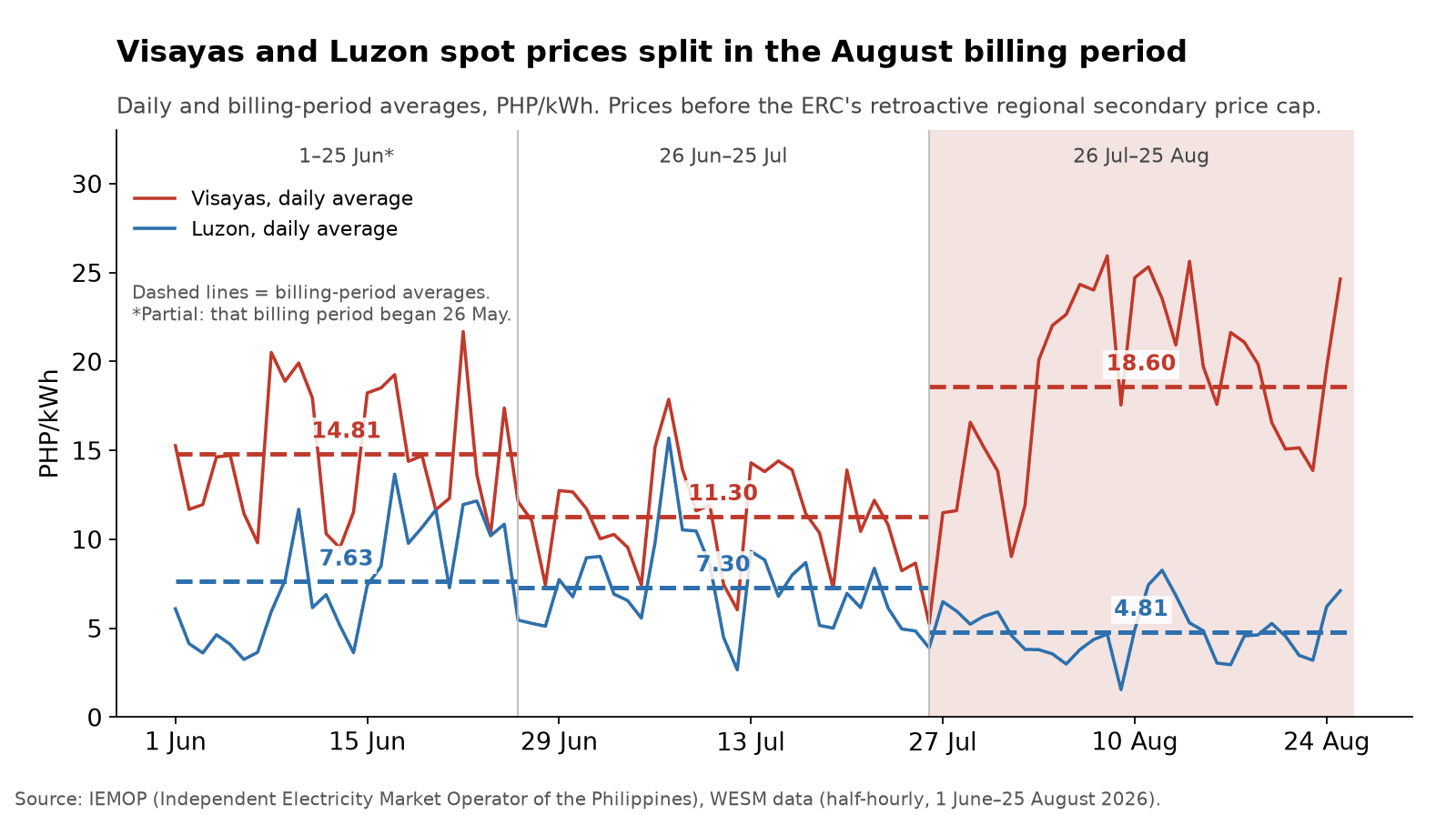
On 9 September 2026, the Independent Electricity Market Operator of the Philippines (IEMOP) reported that the Visayas price in the Wholesale Electricity Spot Market (WESM) averaged 18.59 PHP per kilowatt-hour (kWh) in the August billing period (26 July–25 August), against 4.80 PHP/kWh in Luzon. The two grids share a high-voltage direct current (HVDC) link, yet the Visayas paid almost four times Luzon’s price.
At IEMOP’s 9 September briefing, vice-president Isidro Cacho Jr called it the worst month since the spot market opened. For the Visayas, which joined WESM in 2010, that makes it the highest on record. That number is not the raw one. It already includes the system-wide secondary price cap (SPC), which held prices down for about 33 hours of the Visayas billing period. Without the cap, the Energy Regulatory Commission (ERC) puts the month at 19.72 PHP/kWh. The ERC has since gone further and applied the SPC region by region, backdated to August. That takes the Visayas average down to 8.47 PHP/kWh, and IEMOP was told to reissue August final statements by 20 September.
Coal outages triggered the spike, but the system’s design determined the magnitude of the scarcity event.
What the August number says
The Visayas average rose 64.9% from 11.29 PHP/kWh in July. Available supply averaged 2,201 megawatts (MW) against demand of 2,094 MW. After reserves and transfers, that left a supply margin of 62 MW in the August billing period, down from 252 MW in July, according to IEMOP. With reserves already scheduled below requirement, the margin could not absorb the trip of even one of the grid’s largest coal units, rated 169 MW and 150 MW, each more than twice the margin.
The National Grid Corporation of the Philippines (NGCP) declared 86 hours of yellow alert and 53 hours of red alert during the August billing period, according to IEMOP. Prices stayed high well beyond those windows: the Visayas price was at or above 30 PHP/kWh for about 202 hours, 27% of all half-hours, against 52 hours in July.
Four coal units decide the Visayas margin
From 11 May to 1 July, NGCP reported four units out at once: Therma Visayas Inc. (TVI) Units 1 and 2 (169 MW each), Panay Energy Development Corp. (PEDC) Unit 3 (150 MW), and Kepco SPC Power Corp. (KSPC) Unit 1 (103 MW). That is 591 MW, about 22% of the 2025 Visayas peak demand of 2,691 MW. Plant output data show both TVI units offline throughout 1 June–25 August, a standing 338 MW gap in Cebu, and other coal outages added an average of 142 MW in the August billing period, against 62 MW in July.
Coal and geothermal make up 56% of the 4,200 MW installed at the end of 2025, according to the Department of Energy (DOE). However, NGCP put dependable capacity at 3,173 MW by day and 2,729 MW at night on 1 July. No new baseload plant has been commissioned since TVI Unit 2 in September 2019, and TVI Unit 1 returned on 18 September only to trip again the next day.
Imports were capped at the Leyte–Cebu corridor
Luzon’s supply margin widened by 632 MW in August, yet net imports into the Visayas averaged 73 MW. Prices separated in 85.9% of the billing period, against 46.4% in July, and the HVDC link ran at security-limited levels about 80% of the time because of loading on the Leyte–Cebu link. The link is rated 440 MW, but the DOE puts its practical operating limit at about 250 MW, and flows reached 150 MW in only 16% of half-hours.
The 450 MW Mindanao–Visayas Interconnection Project was rarely congested, with free-flowing transfers in 89% of the billing period (IEMOP), but Mindanao had less to send. Imports averaged 272 MW in the August billing period and fell to daily averages of 116–164 MW on 9–13 August, when GNPower Kauswagan units went offline and Mindanao demand rose, according to NGCP advisories. By 4 September, after Therma South outages, NGCP reported no imports from Mindanao at all.
The fix is years out. At a briefing in early July, NGCP said its 44 billion PHP Cebu–Leyte Lines 3 and 4 project would be completed in three phases, in 2031, 2033, and 2035.
Oil set the price; reserves fell short of requirement
With baseload out and imports capped, the next megawatt came from oil. The ERC says oil-fired plants accounted for about 78% of price-setting dispatch in the Visayas in August; coal and gas had more often set prices in earlier months. Gas- and oil-fired peaking output averaged 114 MW in the August billing period, against 46 MW in July, and 209 MW in half-hours at or above 25 PHP/kWh.
Contingency reserve prices rose 47% and dispatchable reserve prices 26%, with scheduled quantities below requirements of 131 MW and 105 MW. Yet utilisation of firm Visayas contingency reserve contracts was only 0.69% in January–June 2026, per NGCP data cited in a Philippine Star column, and the DOE says NGCP had still not signed all the reserve contracts it was told to, including battery capacity.
The ERC capped Visayas prices and is checking for withholding
The ERC’s order of 10 September in Case No. 2026-048 MC made the SPC regional, so the Visayas cap now triggers on Visayas prices alone. Under ERC Resolution No. 26, s. 2025, the cap applies once the 72-hour rolling generator-weighted average price passes 12.413 PHP/kWh, then holds prices at 7.423 PHP/kWh from the next trading interval until that average falls back below the threshold.
The order also asked the Market Surveillance Committee of the Philippine Electricity Market Corporation (PEMC) to examine offers and dispatch for economic withholding, with findings due within 60 days. The ERC has already said its preliminary view is that scarcity, not conduct, set the price. The probe runs without prejudice to that.
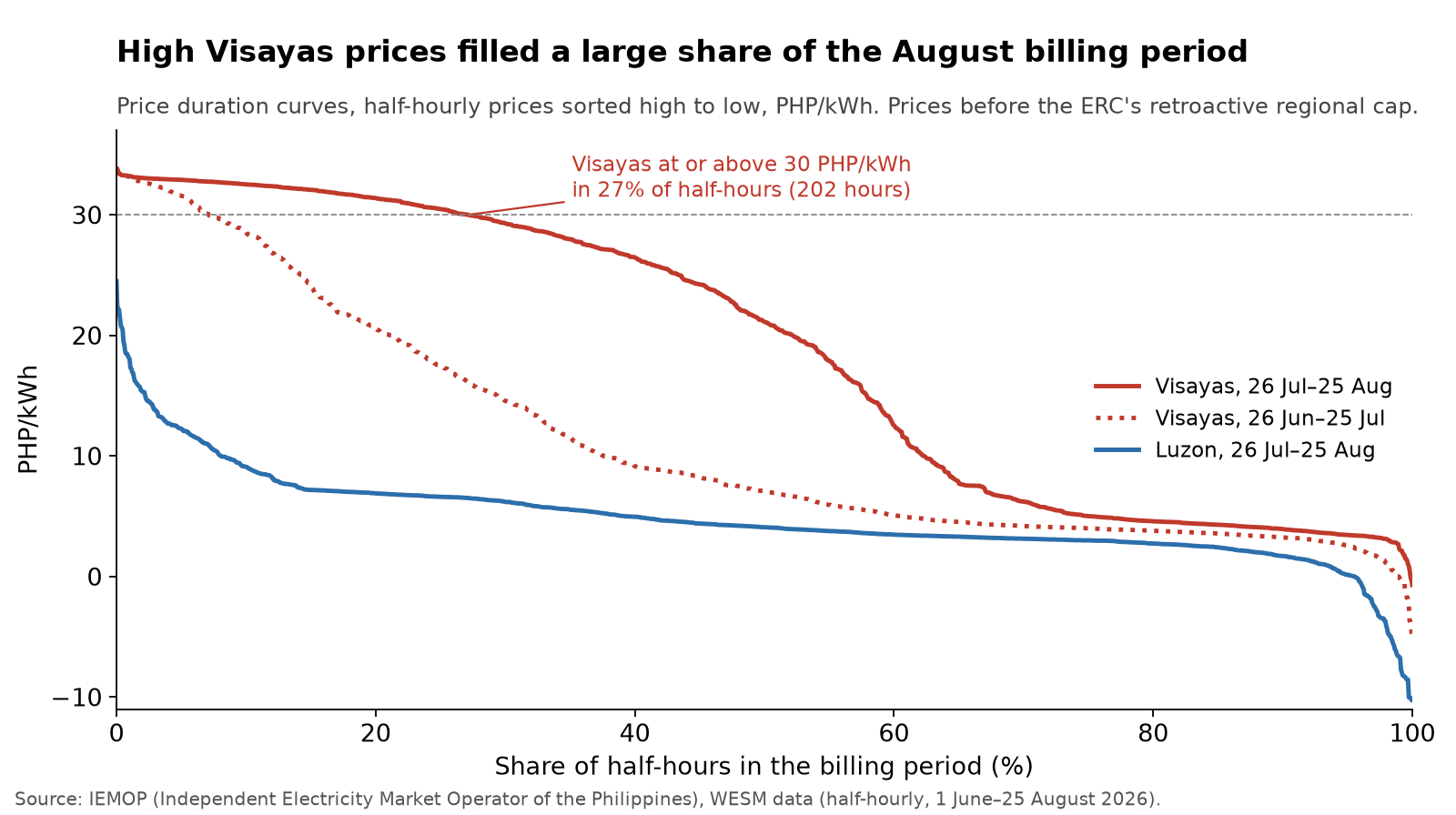
Prices at or above 30 PHP/kWh are when stored energy earns most, and with 202 such hours on the published prices, August was a record month for battery arbitrage. The backdated cap clawed part of that back. August was resettled on the regional cap, and every capped interval now pays 7.423 PHP/kWh. The bigger effect is on what comes next. Between January and August 2026 the system-wide test capped Visayas prices for roughly 190 hours. A regional test would have capped them for nearly 875 hours, because Visayas scarcity no longer has to drag the national average above 12.413 PHP/kWh. The regional cap stays until the ERC lifts it, and PEMC’s review of the high-price rules and the withholding probe run alongside it.
Two implications for developers in the Visayas
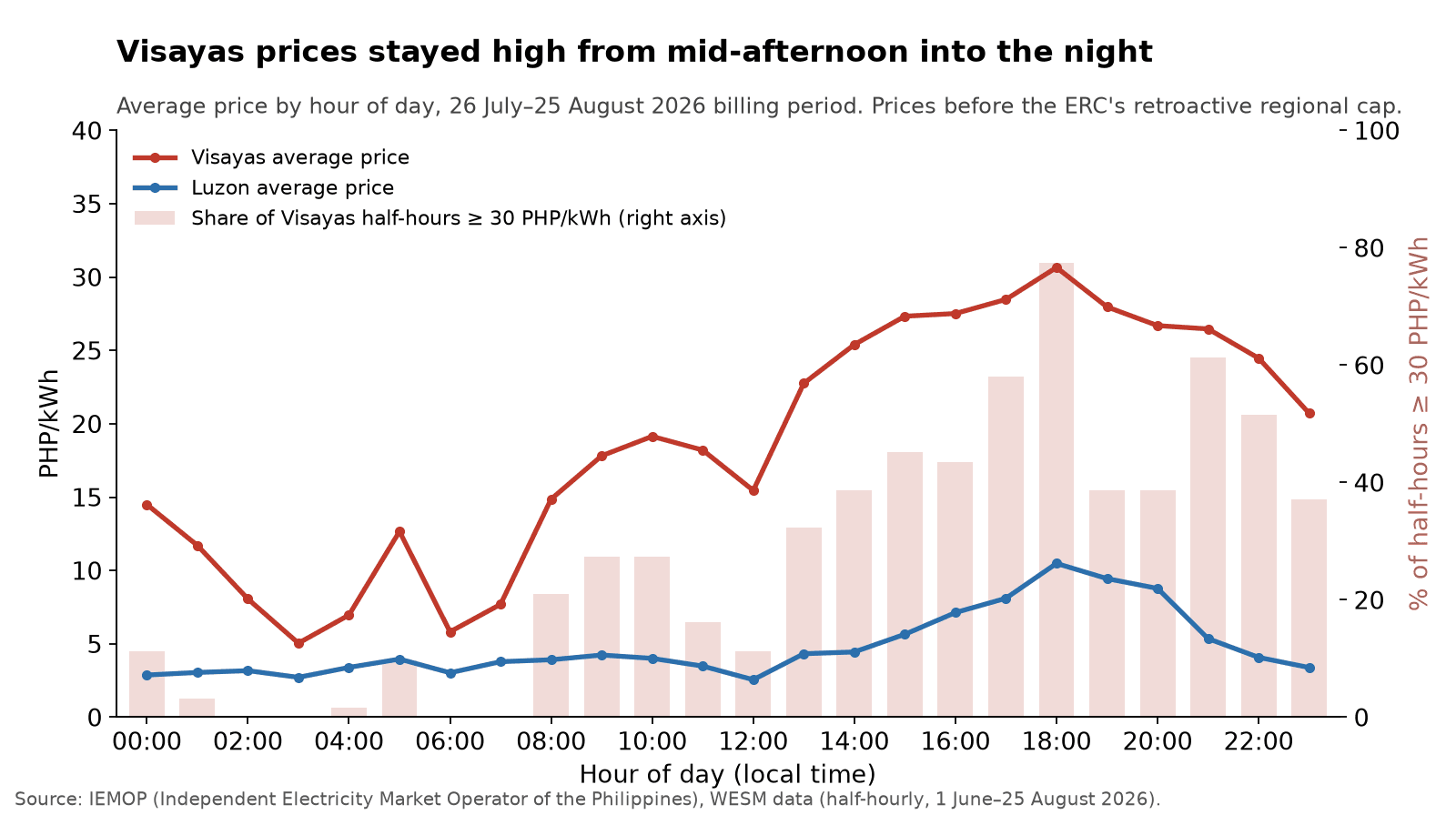
The first implication is that firm evening capacity contracts can help retailers and utilities hedge against the evening peak cost. In the August billing period, on the published prices, the Visayas averaged 28.05 PHP/kWh between 17:00 and 22:00, against 9.83 PHP/kWh between midnight and 06:00. As long as there is a clear view of anticipated customer demand, hedging through a physical contract is doable. Firming or mid-merit contracts can be signed with either peaker plants or solar and battery hybrids. Spot-exposed utilities and cooperatives should have learned what an uncovered position costs, so a firm evening contract is one they should consider signing.
The second implication is about where batteries go. Storage supports the system most where imports cannot reach and the large units sit: behind the Leyte–Cebu constraint, and in Cebu above all, where the two TVI units left a standing 338 MW gap. The DOE’s May 2026 list puts only 110 MW of its 419.9 MW of standalone storage in Cebu, and 80 MW in Leyte and Samar, on the import side of that constraint. The Visayas already had 148 MW of grid batteries at the end of 2025, against an August contingency reserve requirement of 131 MW and a dispatchable reserve requirement of 105 MW. Yet red and yellow alerts were still triggered due to the suboptimal placement of these batteries in the Visayas.
Related insights
- Mandated, Not Monetised: Making Co-Located Storage Profitable in the Philippines
· Storage economics, Ancillary services, Transmission grid curtailment
- The Duck Curve Is Here: What MTerra’s Arrival Means for Every Other Solar Developer in Luzon
· Renewables economics, Storage economics, Economic curtailment
- GEA4: Supporting Clean Energy or Subsidising Poor Siting Decisions?
· Renewables economics, Transmission grid curtailment, Regulation