Malaysia’s 400 MW/1,600 MWh BESS Auction (MyBeST): A Strategic Primer for RFP Bidders
By Patrick Tan ·
Background: Peninsular Malaysia’s Evolving Power Market and the Case for Early BESS
Malaysia’s power sector is at a pivotal transition point. As of 2025, Peninsular Malaysia’s installed solar photovoltaic (PV) capacity has exceeded 2.5 GW, making up more than 7% of the region’s total installed capacity. While this signals strong progress toward a low-carbon future, it also introduces operational challenges to a grid originally designed for centralised, dispatchable generation.
As more intermittent solar power is introduced—particularly through large-scale solar (LSS) schemes—the grid will be increasingly exposed to congestion, curtailment, and mismatches between supply and demand timing. Solar output typically peaks during midday hours, often exceeding demand or local grid export capacity, especially in solar-rich regions. This results in the risk of energy being wasted and puts stress on system reliability.
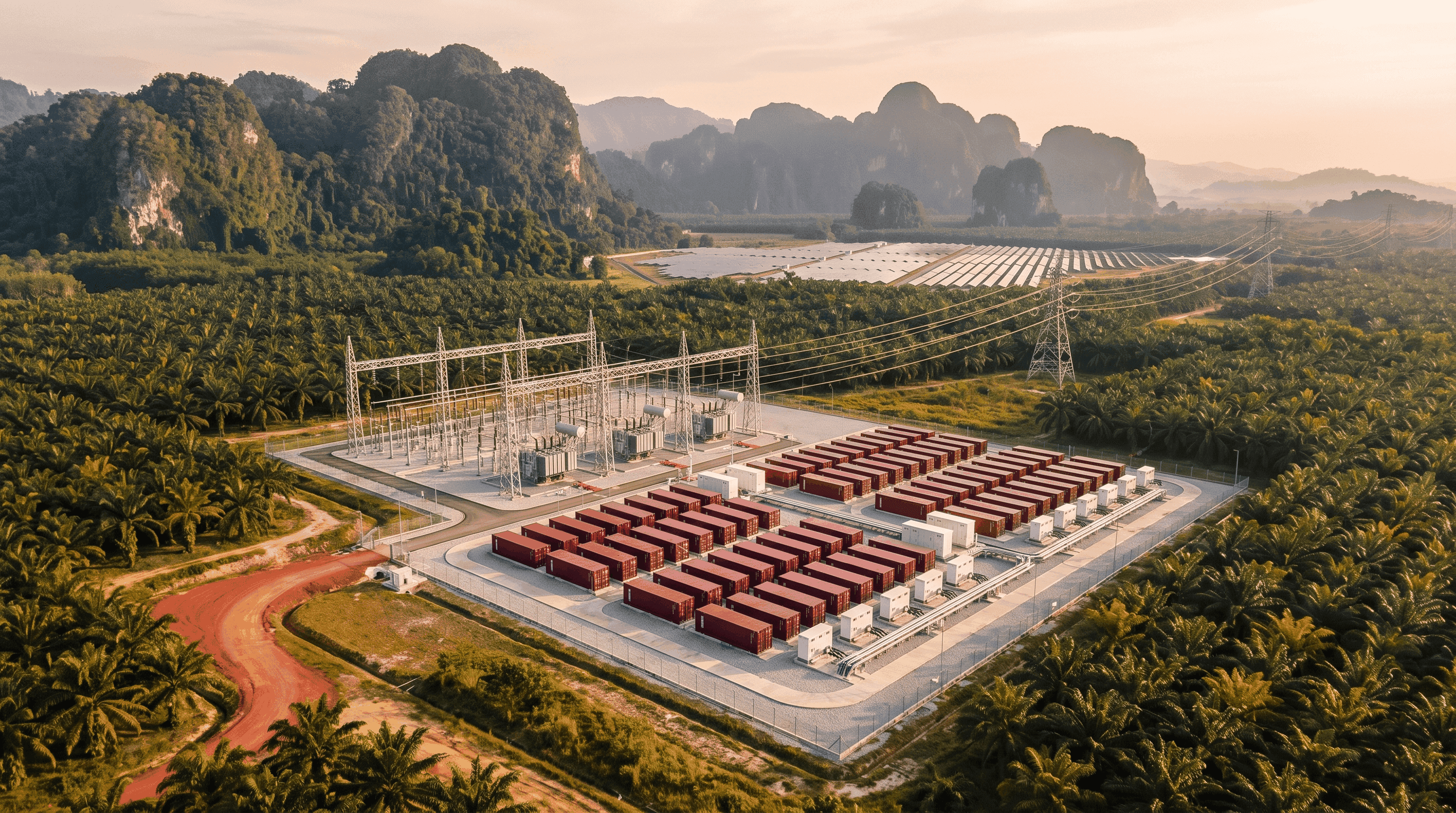
In response, the Energy Commission (Suruhanjaya Tenaga, ST) has taken a proactive step, launching a 400 MW/1,600 MWh Battery Energy Storage System (BESS) programme, with the Request for Quotation (RFQ) released on 29 November 2024. The programme calls for four separate BESS projects, each with a capacity of 100 MW/400 MWh, scheduled to reach commercial operation by 2026. As of mid-2025, the programme has advanced to the Request for Proposal (RFP) stage, where shortlisted developers are preparing competitive bids to be selected as project awardees.
This auction signals a strategic shift. Rather than waiting for grid instability to emerge as a binding constraint, Malaysia is moving ahead to integrate BESS as a core grid asset, aimed at absorbing excess renewable energy, reducing curtailment, and maintaining frequency stability. This early integration positions BESS as a key enabler of future solar expansion, while also establishing commercial precedents for how storage assets can be procured, contracted, and monetised.
Potential Locations for BESS: Insights from Solar Deployment Patterns
While the official list of interconnection points has not been released publicly, useful indicators of where BESS may deliver the greatest system value and utilisation rate can be drawn from the geographical distribution of solar capacity in Peninsular Malaysia.
Under the LSS1 to LSS4 programmes, solar projects awarded have been heavily concentrated in:
- Perak – 542 MW;
- Kedah – 482 MW;
- Terengganu – 324 MW;
- Pahang – 310 MW;
- Selangor – 219 MW; and
- Other states generally host less than 100 MW of installed or awarded capacity.
This concentration of solar generation introduces significant locational stress on parts of the transmission grid. While the central and south western coast of Peninsular Malaysia benefits from a robust 500 kV backbone—running from Perak to Johor—many of the high-solar regions, such as northern Perak, Kedah, and Terengganu, are largely served by lower-voltage 275 kV and 132 kV lines. These regions are thus more vulnerable to congestion risks and curtailment, especially during peak solar hours. The same siting question shows up in how grid position changes renewable returns in the Philippines.
Strategically placing BESS in or near these solar-rich states can mitigate localised grid strain and optimise the utilisation of solar output. Additionally, these locations may experience higher cycle rates for BESS assets—charging during midday solar surplus and discharging during evening peaks. Conversely, states with low solar penetration may see lower utilisation, and therefore lower cycling rates, unless they serve other grid needs such as frequency regulation or congestion relief.
For project developers, this underscores the importance of closely analysing:
- Solar penetration by region;
- Voltage level and grid capacity of surrounding transmission infrastructure; and
- Load demand and net load profile at prospective interconnection points.
Even without a publicly available interconnection shortlist, these locational fundamentals will inform technical feasibility, potential battery dispatch patterns, and ultimately the commercial viability of the project.
The Growing Case for Energy Arbitrage: Price Spreads and the Role of BESS
A prominent revenue stream for battery storage lies in energy arbitrage—charging when electricity is cheap (typically during solar-heavy midday hours) and discharging when prices spike (usually during evening peaks). Co-located batteries in the Philippines earn from the same spread. The viability of this strategy hinges on the gap between low and high system marginal prices (SMP), which we project to widen in the years ahead.
Under the Aurora Central scenario, price spreads in Peninsular Malaysia are expected to remain relatively narrow through 2030 but expand substantially thereafter. By 2040, SMP spreads are forecasted be over 10 times wider, with 4hr spreads reaching ~400 RM/MWh, than those seen in the 2025–2030 period, based on modelling under a cost-based dispatch structure. This transformation is being driven by shifts in the power mix:
- Midday solar output suppresses prices, as high volumes of zero-marginal-cost generation flood the system.
- Evening peaks see higher SMPs, set by marginal gas generators once solar drops off.
- The resulting “duck curve” creates ideal conditions for arbitrage by flexible storage assets. Luzon already shows what that curve does to solar developers.
As Malaysia accelerates its decarbonisation efforts, BESS will become a key enabler of system flexibility, charging when renewables are abundant and cheap, and discharging when demand rises and supply tightens. This not only supports reliability but also enhances the commercial value of each battery cycle.
Currently, there is no regulatory guidance on BESS participating in the wholesale market. While Malaysia’s electricity market is not yet fully liberalised, the direction of reform, particularly around a rising role of the New Enhanced Dispatch Arrangement (NEDA), points to greater opportunities for market-based dispatch and competition. As this happens, energy arbitrage will become a more accessible revenue source for storage developers.
For developers, this emerging arbitrage potential presents a dual opportunity:
- Revenue stacking—Combining contracted revenue streams (e.g. capacity or service payments) with merchant arbitrage to improve project economics
- Futureproofing—Structuring assets and control systems in ways that allow optionality to participate in price-based dispatch in the years ahead
Bidding Strategy: Structuring for Revenue and Risk
BESS projects generally rely on a combination of contracted and merchant revenue streams to recover costs and deliver returns. In the context of this auction, developers can expect to receive:
- A capacity payment (RM/kW), structured within the PPA as a fixed charge for making storage capacity available;
- An energy rate payment (RM/kWh), tied to actual charging and discharging activity, effectively compensating for the service delivered; or/and
- Merchant market upside (RM/kWh), where batteries arbitrage electricity prices by charging at low-cost intervals and discharging at high-cost periods, once market access is enabled.
The optimal bidding strategy depends on how these revenue streams are weighted and how developers balance cost recovery with market risk exposure. Below, we outline three key strategies bidders may adopt under a 15-year PPA horizon, with comparative assessments of each.
- Full Cost Recovery via Capacity Payment — recover 100% of costs through a fixed capacity charge, treating energy and ancillary-service revenue as upside. Gives the highest revenue certainty and the simplest, most financeable structure, but produces a less competitive bid and leaves system-utilisation value on the table.
- Balanced Recovery from Capacity + Energy Payments — split cost recovery across both capacity and energy streams so the capacity bid is offset by operational revenue. More competitive and better aligned with actual asset use, but it assumes reliable dispatch and demands robust O&M and dispatch forecasting.
- Strategy 2 + Merchant Tail (Post-PPA) — same balanced approach, plus assumed merchant revenue in years 16–25 to push the PPA bid lower still and capture long-term spread upside. Most competitive on price and rewards lifecycle optimisation, but takes on long-term merchant and regulatory risk, and relies on the BESS staying healthy well beyond the contract term.
While the strategies above present structured approaches to cost recovery, developers should also be mindful of several technical and commercial risks that may not be fully captured in headline bid numbers:
- High cycle rates may impact BESS warranties
Battery manufacturers typically warrant their systems based on an assumed number of cycles per day or year. If the BESS is dispatched more frequently than the warranted rate, it may void parts of the warranty or accelerate degradation beyond expected levels. - Guaranteeing higher availability or performance may require repowering
Developers offering high availability or aggressive degradation profiles to ST must assess whether the asset can maintain those levels over 15 years. In many cases, this may require mid-life repowering or augmentation, which should be reflected in CAPEX or OPEX assumptions from the outset. - Service payment assumptions must reflect more than operational cost
If developers are relying on energy/service payments as a revenue stream (e.g., Strategy 2 or 3), the unit price must incorporate not just marginal operating costs (like labour or electricity) but also a portion of lifecycle CAPEX, degradation, and financing costs. Under-pricing this can lead to under-recovery of investment.
These risks underscore the importance of realistic operational modelling, OEM engagement during bid development, and lifecycle financial planning, particularly for bidders pursuing more aggressive or market-exposed strategies.
Ultimately, developers have to consider how each strategy aligns with their risk appetite, financing model, and operational capability. For many, the decision will rest on the trade-off between bidding low and securing bankable, forecastable cash flows. As the market matures and merchant pathways become clearer, the viability of more risk-exposed strategies, such as Strategy 3, will likely strengthen.
Bringing it All Together: Key Considerations for BESS Bidding
Malaysia’s 400 MW/1,600 MWh BESS auction marks a significant milestone in its energy transition, offering developers the opportunity to shape the next phase of grid stability and renewable integration. To bid successfully, participants must align technical, commercial, and locational strategies within the framework set by the Energy Commission.
Market Context
Peninsular Malaysia’s rising solar penetration, currently over 2.5 GW, has increased the urgency to deploy storage as a flexible grid asset. By launching this BESS auction ahead of major stability issues, Malaysia is taking a proactive step to future-proof its power system, with COD targeted for 2026.
Siting Strategy
States like Perak, Kedah, Terengganu, and Pahang host the bulk of solar capacity but are also served by lower-voltage transmission lines, making them natural candidates for BESS deployment. These areas are more exposed to congestion and curtailment risks, providing conditions where BESS can deliver the greatest operational and commercial value.
Energy Arbitrage Outlook
As the share of renewables are expected to grow, Aurora Central expects SMP spreads to widen, by more than 10x between 2025 and 2040, creating a strong forward case for energy arbitrage. BESS will increasingly charge during solar-rich intervals and discharge during high-demand peaks, making merchant revenues a considerable long-term component.
Bidding Strategy
Aurora Energy Research assesses three distinct strategies: full cost recovery through capacity payment (low risk, less competitive), a balanced approach blending energy payments (moderate risk), and a forward-looking model that includes merchant tail upside (high risk, high potential). Each path offers trade-offs between competitiveness, bankability, and revenue predictability.
Final Note
Success in this RFP round could go to developers who not only understand the grid and market dynamics today, but who can position their projects to remain valuable and operable in a more flexible, market-oriented future. Careful consideration of siting, cycling behaviour, financial structuring, and merchant optionality will be key to standing out in a competitive field.
Also published on other platforms
Aurora Energy Research website under Aurora Insights: https://auroraer.com/resources/aurora-insights/articles/malaysias-400-mw-1600-mwh-bess-auction-mybest-a-strategic-primer-for-rfp-bidders
BERNAMA business column: https://www.bernama.com/en/news.php?id=2441178
Related insights
- Mandated, Not Monetised: Making Co-Located Storage Profitable in the Philippines
· Storage economics, Ancillary services, Transmission grid curtailment
- Record-Breaking High Prices for the Visayas and Their Implications for Developers
· Wholesale power market design, Regulation, Storage economics
- The Duck Curve Is Here: What MTerra’s Arrival Means for Every Other Solar Developer in Luzon
· Renewables economics, Storage economics, Economic curtailment