Beyond LCOE: How Grid Positioning Shapes Renewable Project Returns
By Patrick Tan ·
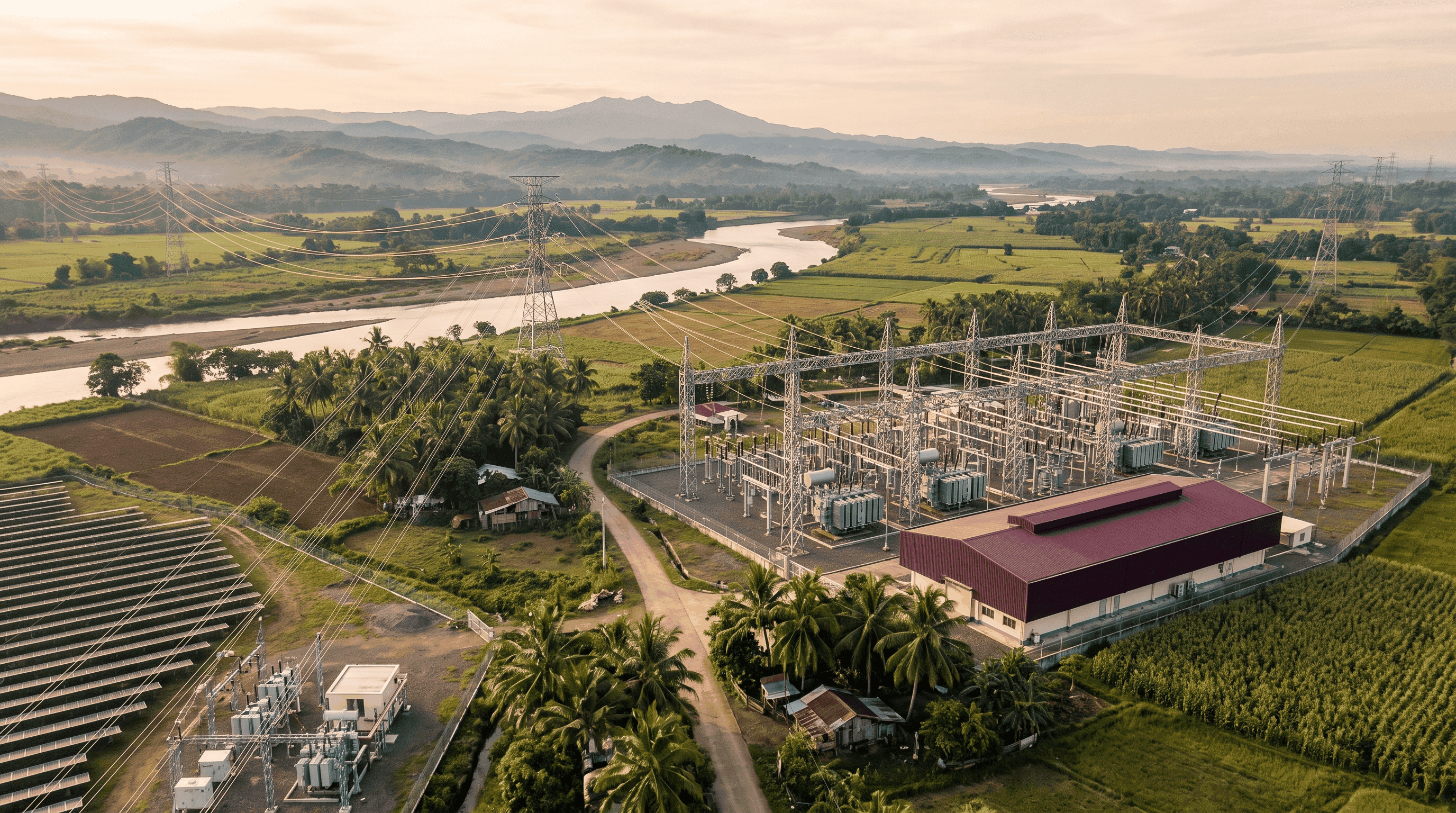
The Philippine Power Market: A Nodal System
The Philippines operates a nodal electricity market—a system design shared with some of the most advanced liberalised markets globally, including the United States (CAISO in California and ERCOT in Texas). In this model, electricity prices vary across hundreds of “nodes” on the grid rather than being uniform across the country. This design allows market prices to reflect localised grid conditions, such as congestion and transmission losses, thereby promoting efficient dispatch and investment decisions.
Wholesale electricity prices in the Philippines are determined by the Wholesale Electricity Spot Market (WESM) using Locational Marginal Pricing (LMP). This means the price of electricity at any given node is composed of three components: the system marginal price, marginal cost of line loss, and marginal cost of congestion.
- System marginal price refers to the cost of the next unit of generation required to meet demand
- Marginal cost of line loss reflects the incremental cost of energy lost during transmission from the generator to the demand node
- Marginal cost of congestion represents the additional cost incurred when transmission constraints prevent the lowest-cost generator from serving load, requiring a more expensive generator to be dispatched instead.
In practice, this structure means that two identical solar projects located in different parts of the country can earn vastly different revenues simply due to where they are connected on the grid.
Route-to-Market Options and Risk Profiles for Renewable Energy
There are four principal routes to market for renewable generators in the Philippines: (1) merchant trading into WESM, (2) power supply agreements (PSAs) with distribution utilities (DUs), (3) corporate power purchase agreements (CPPAs) via Retail Electricity Suppliers (RES), and (4) Renewable Energy Payment Agreements (REPAs) awarded under the government’s Green Energy Auction Program (GEAP). Each comes with a different commercial risk profile, which developers must navigate carefully.
Merchant Trading and Nodal Price Volatility
For projects trading merchant in WESM, the biggest risk is nodal price volatility. Since prices are set locally and fluctuate every five minutes, developers face unpredictable revenue. Price cannibalisation during the midday solar peak, and grid congestion, can depress nodal prices over time. In extreme cases, prices at certain nodes can fall to near-zero due to oversupply or curtailment, eroding project returns, and complicating debt servicing.
CfD-Based Contracts (PSA/CPPA) and Line Rental Cost Risk
For projects with PSAs or CPPAs structured as contracts for difference (CfD), developers are paid a fixed strike price but must still sell their energy into WESM. If the price at the buyer’s node is higher than the generator’s node, the developer may need to absorb the difference—known as the line rental cost, depending on contractual terms between generator and offtaker. This can become significant in congested grid zones, effectively reducing net revenue and shifting delivery risk onto the generator. Under this contractual structure, it is vital for developers to understand how basis risk will affect their returns.
REPAs and Curtailment Risk
In contrast, projects under the GEAP are shielded from price volatility, but they face curtailment risk. REPAs offer a fixed tariff for delivered energy, but do not compensate for energy that cannot be dispatched due to grid constraints. As curtailment becomes more common—especially in high-renewable areas like Negros and northern Luzon—developers under GEAP must be confident in grid access and interconnection timelines. Another commercial risk is the performance bond requirement; projects failing to meet commercial operation milestones risk forfeiting a substantial financial guarantee.
Why Location Matters More Than Ever
While traditional development strategies may prioritise land availability, permitting ease, or social licensing, grid dynamics must now be a central consideration. A well-sited project from a land or resource perspective can still underperform financially if located at a weak or congested node. As the system grows more renewable-intensive, the economic value of a megawatt will increasingly depend on where it is injected into the grid—not just its generation cost.
In evaluating site viability, developers must assess three key grid-related indicators:
- Future renewable buildout near the node, which increases curtailment and cannibalisation risk;
- Projected load growth in the broader region, which supports stronger nodal pricing and lowers basis risk; and
- Historical and forecasted curtailment trends, particularly under high solar or wind penetration conditions.
Tools such as long-term nodal price forecasting and grid congestion analysis (over asset life horizon), and energy storage dispatch modelling are increasingly used to complement traditional site selection metrics.
Lessons from Nodal Markets Abroad
The Philippines is not alone in grappling with these challenges. In markets like ERCOT and CAISO, developers who chose locations without understanding transmission constraints often suffered poor capture prices or faced chronic curtailment. These global parallels reinforce the need for Philippine developers to adopt sophisticated locational screening as a standard part of the project development toolkit.
Ultimately, a low levelised cost of energy (LCOE) is no longer enough. What matters most is the realisable value of energy in context of nodal pricing and generation curtailment risk. Projects that proactively account for these dynamics—through location-aware bidding strategies, co-located storage, and robust interconnection planning—will be the ones that secure offtake, attract financing, and deliver sustained returns.
Also published on other platforms
Aurora Energy Research under Aurora Insights: https://auroraer.com/resources/aurora-insights/articles/beyond-lcoe-grid-positioning-philippines
Related insights
- GEA4: Supporting Clean Energy or Subsidising Poor Siting Decisions?
· Renewables economics, Transmission grid curtailment, Regulation
- Green Dreams, Bankable Schemes: How to Thrive in the Philippine Power Market
· Renewables economics, Wholesale power market design, Transmission grid curtailment
- Mandated, Not Monetised: Making Co-Located Storage Profitable in the Philippines
· Storage economics, Ancillary services, Transmission grid curtailment