Auction, Contract, or Merchant: Three Routes to Market for Philippine Solar Plus Storage
By Patrick Tan ·
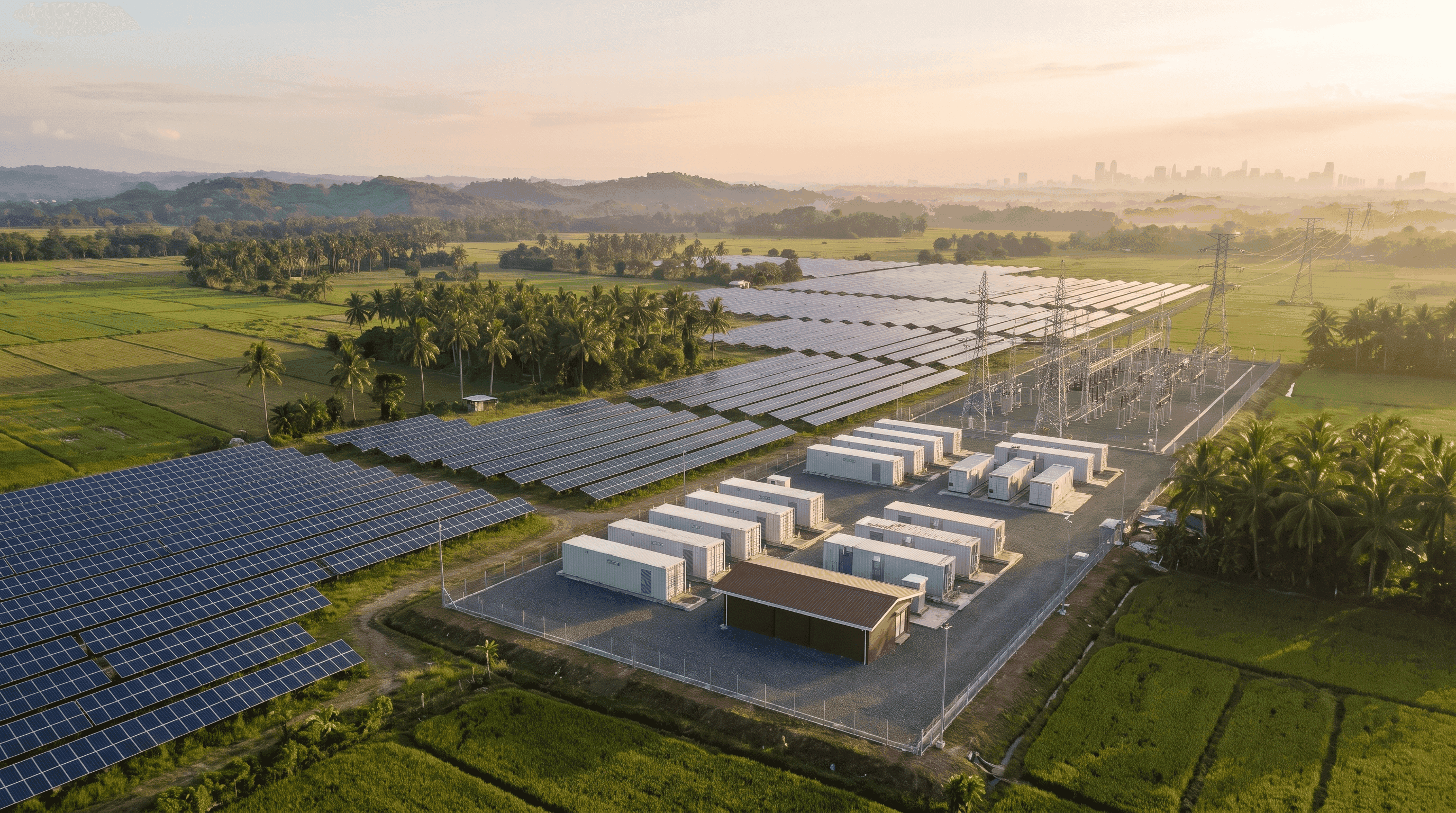
In February 2026, the Department of Energy (DOE) made storage a condition of project development for large variable renewables. Department Circular No. DC2026-02-0008 requires prospective variable renewable energy (VRE) plants of 10 MW and above to integrate energy storage equal to at least 20% of installed capacity, consistent with system studies and technical requirements. Issued on February 16, 2026 and effective upon Official Gazette publication on February 20, 2026, the circular applies to prospective plants in that size band, excluding existing project pipelines with active service contracts. The mandate specifies the minimum storage power capacity in megawatts, while leaving discharge duration open for developers to optimize.
This mandate sits on top of the Integrated Renewable Energy and Energy Storage System (IRESS) category defined in DC2025-09-0014 in September 2025. Prospective VRE plants of 10 MW and above must integrate an energy storage system (ESS) of at least 20% of installed capacity. System Impact Study or Distribution Impact Study findings can adjust that sizing, and the system operator or network service provider can recommend a derogation where those studies show that integration would compromise grid or network stability. For developers using batteries to meet the requirement, the commercial question is how they earn revenue. There are 3 route-to-market options, and each leaves the generator holding different commercial risks. Choosing the right commercial strategy is now as important as meeting the basic storage requirements.
The auction route leaves curtailment as the core residual risk
The Green Energy Auction (GEA) gives the most revenue certainty among the three routes. The winning bid becomes a fixed Green Energy Tariff (GET) on delivered energy under a Renewable Energy Payment Agreement (REPA), recovered from the wholesale market and funded by consumers. Curtailment is the core residual risk on eligible delivered energy, because GET revenue depends on metered delivery.
GEA-4 was the first auction with IRESS as its own category. Auction design required at least four hours of storage per IRESS project, a duration requirement separate from the later 20% capacity minimum requirement. Each winner receives a pay-as-bid GET, capped at the Green Energy Auction Reserve (GEAR) price set by the Energy Regulatory Commission (ERC).
The GET is recovered from the wholesale market and the remaining deficit is collected from on-grid consumers through the Green Energy Auction Allowance (GEA-All). The National Transmission Corporation (TransCo) administers the GEA-All Fund and pays eligible generation under the REPA. A fixed GET for eligible delivered energy protects that revenue from direct Wholesale Electricity Spot Market (WESM) nodal-price exposure.
Curtailment is different. Under the GEA framework, the GET is paid on energy delivered and metered into the market. Curtailment reduces metered energy and therefore GET revenue. Must-dispatch status under the Renewable Energy Act (RA 9513) does not protect IRESS from transmission and distribution grid curtailment risk. Congestion that depresses prices at a node also raises the odds of curtailment there.
A mid-merit contract prices firming hours and adds delivery risks
A mid-merit power supply agreement (PSA) with a distribution utility (DU), or a contract with a Retail Electricity Supplier (RES), provides a bilateral price for an agreed delivery profile. Firming hours affect the cost of meeting that profile. And, that commitment introduces risks, such as solar intermittency that leads to WESM shortfall purchases, line rental cost exposure, and grid curtailment risks.
Distribution utilities buy mid-merit supply through a competitive selection process (CSP). The ERC approves the resulting rates. A contract that also covers the evening peak may need a larger battery, or a longer-duration battery energy storage system (BESS), than the minimum requirement set by the DOE mandate. Insufficient storage or alternative firming exposes the seller to replacement-power purchases or contractual shortfalls.
Solar intermittency is the first added risk. The obligation is firm, but the sun is not. Cloudy days and prolonged typhoon weather reduce the solar energy available to charge the battery. The seller must still cover the contracted volume through replacement supply or pay under the contract's shortfall terms.
Line rental is the second. These contracts work like a contract for difference. The generator sells into WESM at its own node, while the buyer takes delivery at another. Line rental is the price difference between the two nodes, settled on the contracted quantity. The contract allocates line rental. A generator that accepts delivery-node exposure absorbs the difference. Nodal price differences within a grid can be significant in congested zones.
Lastly, curtailment stays with the generator. A curtailed seller loses the energy and still owes the contracted volume.
Merchant sales trade contract risk for market volatility
A merchant solar and storage project sells energy into WESM and qualified battery capacity into the reserve market, with no long-term offtake contract. The merchant route's risk is volatility in both markets. Energy spreads and reserve prices swing sharply from month to month and between grids.
A battery earns merchant revenue by shifting solar output to higher-priced periods and by providing qualified reserve capacity. Regional supply conditions lift spot and some reserve prices in one grid while another softens. Volatility cuts both ways.
What lenders, developers, and offtakers should take from the mandate
The DOE mandate set an ESS integration requirement for prospective VRE plants of 10 MW and above. It did not settle how that storage gets paid. For lenders, developers, and offtakers, the commercial structure now decides the risk that underwriting, sizing, and contracting have to absorb.
For lenders, underwrite the commercial risks that belong to the chosen structure. A GEA IRESS loan turns on curtailment and delivery. A mid-merit PSA loan turns on firming hours, WESM shortfall purchases, line rental allocation, and curtailment. A merchant facility turns on energy and reserve price paths. The same battery looks bankable under one structure and fragile under another.
For developers, optimize BESS specification and sizing for the commercial structure, not only for the 20% minimum capacity requirements. Storage that meets the GEA-4 IRESS four-hour minimum satisfies that auction's delivered-energy design rule. A higher MW rating supports greater delivery power; more usable MWh at a given discharge power supports longer delivery windows. Project location still matters, because the connection node determines how much curtailment and line rental the project absorbs.
For RES and DU offtakers, willingness to consider tolling helps bankability. A tolling agreement transfers utilization and market-price risk to the RES or DU in exchange for a capacity fee; availability and performance risk stay with the owner unless the contract reallocates them. The RES or DU must then use the BESS to improve portfolio performance enough to justify the fee.
The mandate made ESS integration a requirement for prospective VRE plants of 10 MW and above. For solar-plus-battery projects, the route to market determines whether the battery supports a financeable revenue story.
Related insights
- The Duck Curve Is Here: What MTerra’s Arrival Means for Every Other Solar Developer in Luzon
· Renewables economics, Storage economics, Economic curtailment
- Record-Breaking High Prices for the Visayas and Their Implications for Developers
· Wholesale power market design, Regulation, Storage economics
- Mandated, Not Monetised: Making Co-Located Storage Profitable in the Philippines
· Storage economics, Ancillary services, Transmission grid curtailment