The Real CRESS System Access Charge Is Still 18 Sen/kWh
By Patrick Tan ·
The Corporate Renewable Energy Supply Scheme (CRESS) is a third-party access program that allows renewable energy developers to sell electricity directly to corporate consumers through the grid in Peninsular Malaysia. Buyers gain another procurement option without requiring a private wire.
Once the customer and the developer reach an agreement, they sign a Bilateral Energy Supply Contract (BESC). The grid carries the electricity from the developer's operating asset, and Tenaga Nasional Berhad (TNB) supplies the customer's remaining needs. The Energy Commission of Malaysia (ST) also confirms that a Green Consumer is still subject to the Maximum Demand Charge after participating in CRESS.
What the Acceleration Package changes
CRESS began with a firm System Access Charge (SAC) of 25 sen/kWh. In August 2025, the Government reset the firm SAC to 20 sen/kWh for Regulatory Period 4 (RP4). Under the CRESS Guidelines, that charge is fixed for each three-year Incentive Based Regulation (IBR) Regulatory Period and may change only at the start of a new period, subject to a maximum variation of 15% from the prevailing charge.
On October 15, 2026, ST announced a 14 sen/kWh developer SAC for qualifying firm supply under the CRESS Acceleration Package, fixed for 10 years from the Commercial Operation Date (COD). Eligible projects must achieve COD by December 31, 2028, and commit to a minimum 10-year contract. However, under the new announcement, the customer is now charged a separate and new CRESS SAC (on the customer side) of 4 sen/kWh. This SAC rate is subject to review under the regulated tariff mechanism that applies to all consumers at each Regulatory Period.
CRESS is a buyer's market, and the BESC defines the party who is liable for SAC risk
Electricity tariffs in Peninsular Malaysia are differentiated by voltage class. Higher-tariff customers set a higher ceiling price for CRESS negotiation. Lower-tariff customers set a lower ceiling. If the total cost of CRESS, including generation, battery energy storage, and the System Access Charge, exceeds that ceiling, the customer realizes no savings and may pay a premium to participate.
Published RP4 non-domestic energy rates illustrate the gap. Low-voltage (LV) General, medium-voltage (MV) General, and high-voltage (HV) General are published flat energy rates of 27.03, 29.83, and 43.03 sen/kWh. Ultra High Voltage (UHV) has no published General energy rate and TNB places data centers under the UHV category, which is billed on a time-of-use basis at 55.18 sen/kWh peak and 51.09 sen/kWh off-peak.
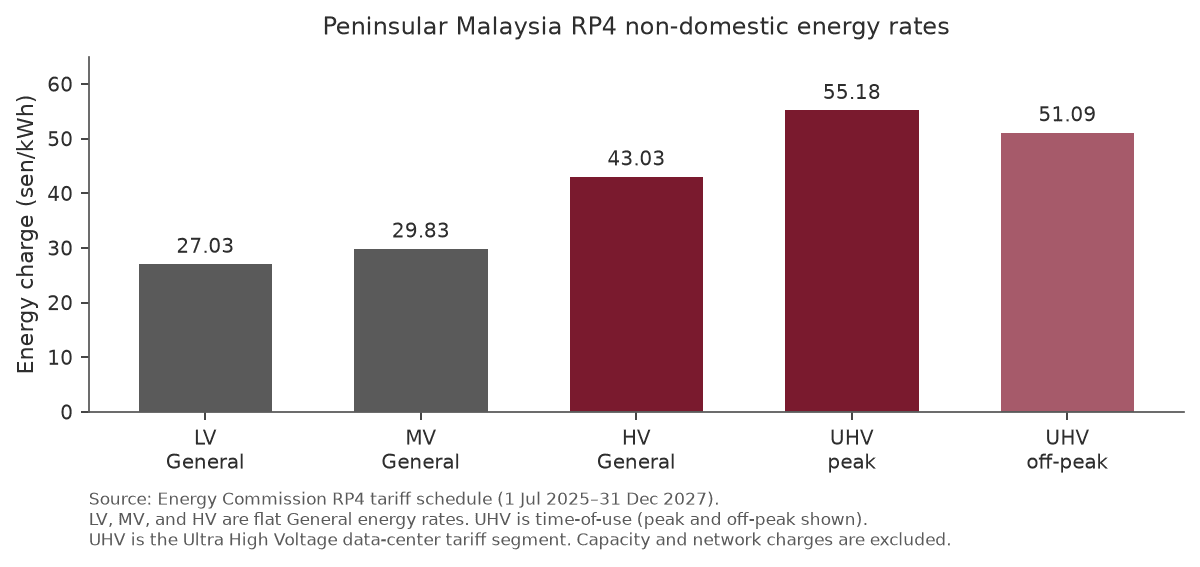
On current assessment, only HV and UHV customers can afford CRESS with some savings relative to the conventional industrial tariff from TNB. After the 18 sen/kWh SAC, about 9 sen/kWh is left at LV and about 12 sen/kWh at MV before generation and storage costs, against about 25 sen/kWh at HV and about 33 to 37 sen/kWh at UHV. That limits the reachable offtaker pool to HV and UHV customers, a much smaller set than the number of CRESS developers in Malaysia. CRESS is therefore a buyer's market.
The challenge of a buyer's market is that customers hold stronger negotiating power. Before the Acceleration Package, customers pushed developers to absorb SAC uncertainty, agreeing only to a fixed SAC contribution over the contract term while leaving the developer to absorb any upward reset. Now, the Acceleration Package locks the developer SAC at 14 sen/kWh for 10 years from COD, which appears to resolve that tension. However, at the same time, ST introduced a new consumer-side SAC of 4 sen/kWh with no published variation cap and subject to review every Regulatory Period. Because the market dynamic remains a buyer's market, customers are pushing that consumer SAC uncertainty back onto the developer through the BESC price.
SAC fundamentals
Whether SAC uncertainty is borne entirely by the developer, entirely by the customer, or shared between them, neither side can put an unbounded figure into its projected cash flow. For the developer, an open-ended SAC path makes project returns uncertain and generally makes the project uninvestable. For the customer, accepting an uncapped SAC path is the equivalent of signing an empty check for ST to fill in and committing to pay whatever ST later decides to charge.
SAC can still be forecasted from fundamentals. ST presented the SAC components at its CRESS Acceleration Package briefing on October 13, 2026, and allocated them between Renewable Energy Developers (REDs) and Green Consumers (GCs):
- Integration and Balancing. The cost of fast-response resources required to maintain system balance as renewable-energy integration increases.
- Operation and Regulatory. The cost of managing the electricity system to support the CRESS program.
- Market Development. The costs of enabling the development and integration of CRESS and other emerging market mechanisms.
- System Augmentation. The costs of strengthening and expanding the electricity system to support increased renewable-energy integration.
Most of those components are grid-investment related. TNB has set out a RM43 billion investment from 2025 to 2027 to strengthen and modernize the National Grid, covering the same years as Regulatory Period 4. That investment is recovered over time through the regulated asset base (RAB) in general tariffs. And, the SAC recovers the network and system-service costs associated with CRESS under Guidelines clause 11.1. Therefore, the RM43 billion is not a RAB figure, some of the CRESS-related network and system-service costs of these investments are expected to be recovered via the SAC mechanism. With a long-term capacity forecast, market participants can estimate the investment path and therefore the direction of SAC adjustments at each Regulatory Period. Whether the published structure is a single developer SAC of 20 sen/kWh or a 14 sen/kWh developer charge plus a 4 sen/kWh consumer charge, the total remains about the same. The real SAC is still 18 sen/kWh. The split changes who is billed. It does not change the underlying capital recovery mechanism required for these grid investments.
What lenders need to assess
There are three risks to assess when financing a CRESS project.
The first is the merchant tail after the initial contract. Residual output can be priced off the system marginal price (SMP) as a proxy, but the Acceleration Package announcement does not set out how a project earns revenue after the BESC ends. An alternative case assumes the asset signs a second BESC for years 11 to 20 at a new SAC rate. Cash-flow results differ under that case, because under current CRESS design the developer may need to repower its battery energy storage system to maintain a targeted load factor.
The second is SAC uncertainty risk. Whether that risk is shared or borne entirely by the developer, lenders need to assess how SAC will change from fundamentals over the life of the debt, including the path of the consumer 4 sen/kWh charge if the BESC pushes it back onto the generator through a lower contract price. The BESC needs to state who bears each charge, how changes pass through, and whether either party can reopen or terminate the agreement.
The third is COD risk. The developer's ability to deliver on time is decisive. Projects that achieve COD after December 31, 2028, lose the Acceleration Package and face the prevailing SAC. The published general firm rate today is 20 sen/kWh, and that general rate remains subject to adjustment at each Regulatory Period. Financial close requires a credible construction and connection schedule, contractual allocation of delay costs, and enough liquidity to meet debt service if commissioning slips and package eligibility is lost.
Related insights
- Korea Rewrites Who Gets on the Grid: Solar Connects Sooner, but the Project Carries the Curtailment Risk
· Transmission grid curtailment, Renewables economics, Regulation
- GEA4: Supporting Clean Energy or Subsidising Poor Siting Decisions?
· Renewables economics, Transmission grid curtailment, Regulation
- Auction, Contract, or Merchant: Three Routes to Market for Philippine Solar Plus Storage
· Storage economics, Renewables economics