Korea Rewrites Who Gets on the Grid: Solar Connects Sooner, but the Project Carries the Curtailment Risk
By Patrick Tan ·
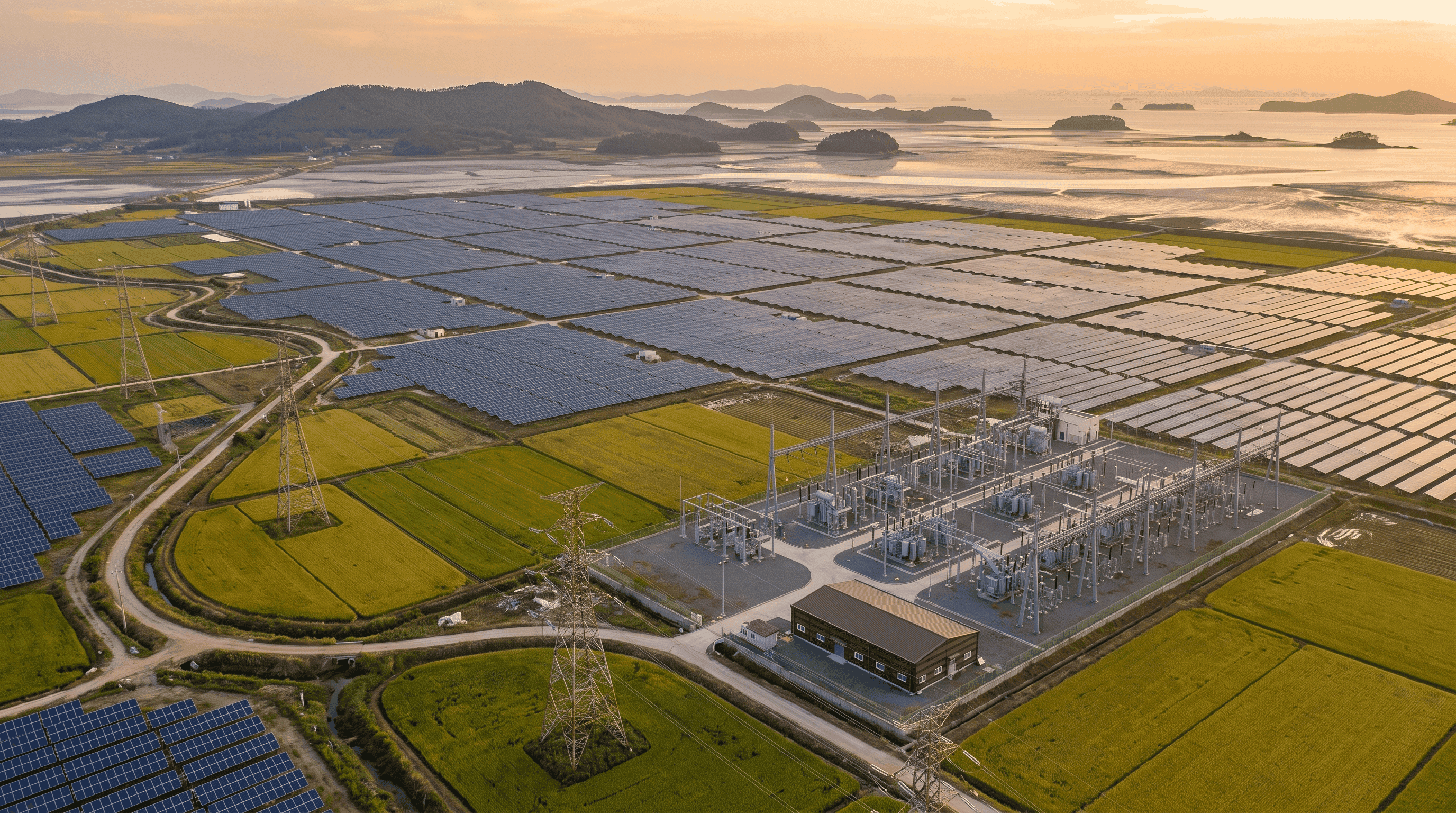
On 29 September 2026, the Ministry of Climate, Energy and Environment took its Power Grid Innovation Plan to Cabinet. Two days later, the grid-management substation designation that had frozen new renewable connections across Honam since 2024 was lifted. Under the old rules, a new solar project in Korea’s main solar region could not expect a connection before 2034.
A 345 kilovolt (kV) transmission line takes more than nine years to build and a 154 kV substation about six, so the government will run the existing network harder and take back unused capacity. For solar developers, that opens the door years early. It also swaps years in the queue for curtailment risk that sits with the project.
What changed on 29 September
Korea has mostly sized connections on nameplate capacity, even though solar peaks at around 80% of nameplate and solar-dedicated distribution feeders run at about 15% utilization. Non-firm (flexible) access lets a project connect above the firm limit on condition that its output is cut whenever actual flows exceed what the line or transformer can carry.
Curtailment-conditioned connection began in late 2024, and a July 2025 round offered 1.9 gigawatts (GW) of distribution-level flexible access in Honam. The plan scales up non-firm access. The solar cap rises from 14 megawatts (MW) to 16 MW per feeder from January 2027, and from 50 MW to 60 MW per substation after a trial starting in December, which the ministry says lets another 2.6 GW of solar connect in Honam without building any new lines or substations.
The catch is in two conditions. First, non-firm plants are curtailed before other plants when the grid saturates. Second, the plan has no rule on compensating them for the lost output. Briefing reports say the curtailment condition lifts once the grid is reinforced, which ties a project’s exposure to the reinforcement schedule of Korea Electric Power Corporation (KEPCO).
The plan also offers an alternative to non-firm access, which the ministry calls autonomous connection. Under non-firm access, the grid operator cuts the plant’s output when the network is full. Under autonomous connection, the developer builds 2–3 times as much solar as its grid connection is rated for and uses a co-located battery to store the surplus, so the plant itself keeps its exports within the permitted limit. After a pilot this year, it will roll out in 2027, and the ministry concedes it depends on battery economics.
The ministry plans about 40 MW of storage at each of the 41 saturated Honam substations, which it says will let another 1.6 GW of solar connect by 2030, plus feeder batteries in saturated areas for another 3 GW of solar. The ministry has not said how many hours of storage these batteries will hold, so it is hard to judge how much curtailment they will absorb.
The government and KEPCO have already reclaimed about 9 GW of connection rights from paper projects. Honam offshore wind holds 15.8 GW of grid rights for the period to 2030, yet the ministry expects only about 3 GW of it to connect by then. The rights survive, but more than 10 GW of connection dates move to around 2033, including public projects, and faster projects such as solar get the capacity in between.
Grid capacity has so far been allocated as if every licensed renewable project goes ahead on schedule. For projects due to connect from 2031, the ministry will assume that only about two-thirds (67.2%) of licensed projects actually go ahead, so it can hand out more connection rights on the same grid.
In Honam, the result is that 46 of 87 substations have spare capacity now, and the other 41 open in stages over 2028–2030. Queued projects could apply from 1 October, and new applications open in January 2027.
What it means for developers and lenders
Four consequences follow, in the order a project will feel them.
1. Earlier commercial operation dates (COD) for Mainland solar
About 90% of Korean solar connects at distribution level, which is where the new caps and feeder batteries apply. A permitted project in one of Honam’s 46 open substation areas, or in Chungcheong, where 105 of 108 substations have room, can now plan a COD in 2027 or 2028, six or seven years earlier than the old rules allowed. Freed capacity goes first to projects already in the queue. After that, projects that can be built before offshore wind returns around 2033 gain most, so being ready to build matters more than applying early.
2. Curtailment becomes unavoidable
Every measure in the plan pushes more energy through the same network, and relief from reinforcement is six to nine years away. Korea Power Exchange (KPX) data shows the network is already the main constraint. Of the 146 Mainland curtailment days from October 2024, when KPX began publishing monthly values, to August 2026, 118 (81%) were caused by grid constraints alone. Economic curtailment, when supply exceeds demand across the system, caused 2 days (1%) on its own, and the other 26 (18%) involved both.
Curtailment peaked in spring in both years, at 36 days in the second quarter of 2025 and at 14 days in April 2026 and 19 in May (Figure 1). It is not easing: the first half of 2026 had 54 days, against 55 a year earlier.
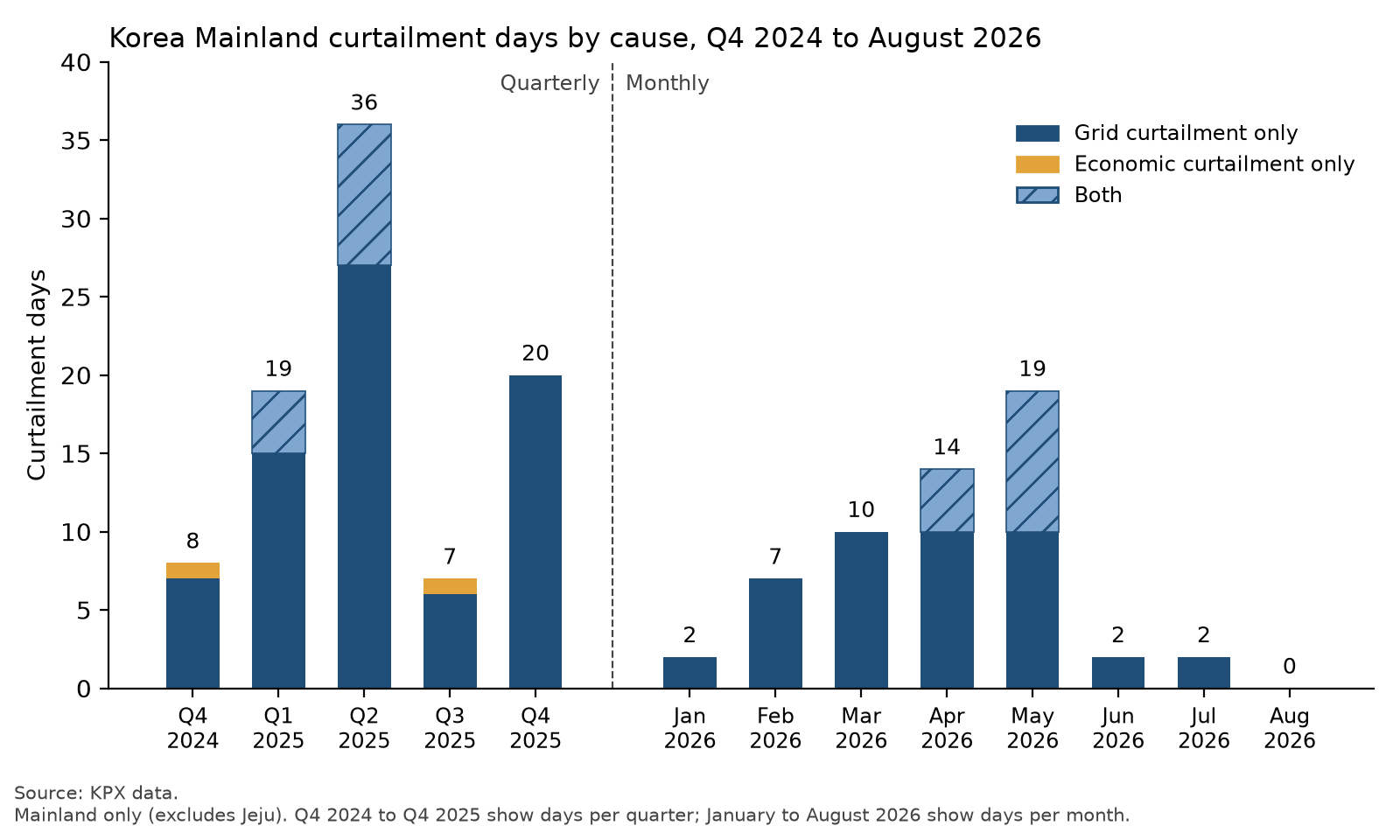
Day counts show how often curtailment happened, not the megawatt-hours (MWh) lost, and both half-year totals predate the 1 October reopening of Honam connections. Whether curtailment grows on saturated Honam feeders depends on how fast new solar connects under the higher caps, against the staged opening of Honam’s 41 saturated substations over 2028–2030, which published KPX data cannot show yet. Deferred offshore wind returning around 2033 will add to the pressure.
3. Bankability depends on location
Two plants with identical irradiance and offtake prices can face different curtailment depending on the feeder, the substation, how much capacity connected ahead of them, and how long they stay non-firm, possibly indefinitely. With no compensation rule for non-firm plants, every curtailed MWh comes straight off the P75 or P90 yield cases that size the debt.
The partial exception is the renewable semi-central dispatch scheme run by KPX. In spring 2026 it paid participating plants 9.42 KRW/kWh on their 10:00–17:00 output, on top of the wholesale price, in return for following KPX dispatch within one minute and submitting day-ahead forecasts. When KPX curtails them, the payment is calculated on their submitted schedule, but the energy revenue is still lost. Autumn eligibility was tied to Honam’s grid-management substations, a designation lifted on 1 October, and KPX has not said whether new non-firm plants can join.
Lenders should expect a feeder-level curtailment study in the data room. It needs hourly flows at feeder and substation level, queue position under the new caps, the date KEPCO’s reinforcement or grid battery arrives, and a sensitivity for the 2033 offshore wind return. The KEPCO-On portal’s spare capacity by substation and year is a starting dataset, but it will not substitute for the study.
4. Batteries need a policy of their own
The plan leans on battery energy storage systems (BESS), but only the grid-side piece has numbers attached: about 5 GW on feeders and substations by 2030. The feeder batteries are funded half by the state and half by virtual power plant (VPP) operators.
Without a revenue signal for co-located batteries, most developers will take a non-firm connection and absorb the curtailment. Moon Go-young, co-CEO of RWE Renewables Korea, estimated that overbuild, flexible access, and a 10 MW/20 MWh battery could lift a 20 MW connection point to about 36 MW of generation, for planned curtailment of 3–5% a year. Korea needs a defined storage volume in the 12th Basic Plan for Electricity Supply and Demand and a payment that rewards shifting midday solar into the evening, and battery-backed plants should sit further back in the curtailment order than plain non-firm plants.
Korea has decided that solar can connect before the network is ready. Lenders will now decide, feeder by feeder, which of those connections are worth financing.
Related insights
- GEA4: Supporting Clean Energy or Subsidising Poor Siting Decisions?
· Renewables economics, Transmission grid curtailment, Regulation
- Beyond LCOE: How Grid Positioning Shapes Renewable Project Returns
· Renewables economics, Transmission grid curtailment
- Green Dreams, Bankable Schemes: How to Thrive in the Philippine Power Market
· Renewables economics, Wholesale power market design, Transmission grid curtailment